
Curriculum Design
At the Flying High Academy Ladybrook, all of our teaching and learning aims to equip students and staff with the skills they need to reach their full potential. Through using a research-led model, teachers are empowered to produce exciting and well-thought-out lessons that support pupils' holistic development.
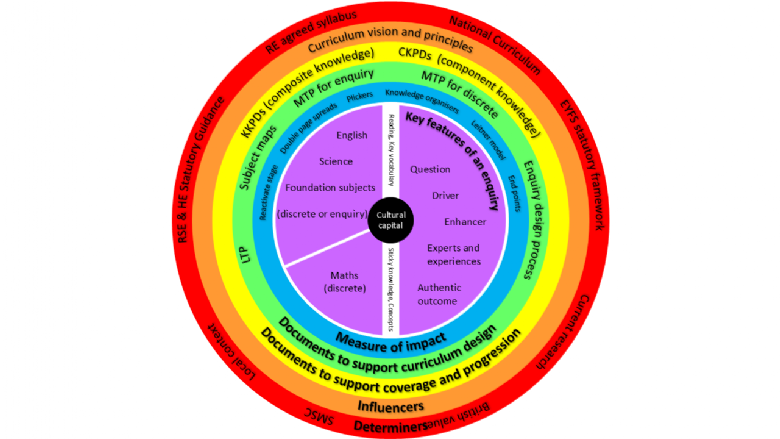
Our Curriculum Model Graphic
Using the graphic shown above (developed in line with the National Curriculum and the EYFS Framework), our curriculum is designed to be coherent, progressive and responsive to the needs of our pupils. It is structured around the key determiners; enriched by school-specific priorities and influences; and carefully mapped using national and local guidance to ensure both breadth and depth of coverage. Supporting documents provide clear breakdowns to guide effective planning and delivery.
The impact of this curriculum is evaluated through a balanced approach to assessment, using both formative and summative tools to monitor progress, inform teaching and ensure that all children achieve well.
Below is a short presentation explaining how our curriculum has been designed and engineered.
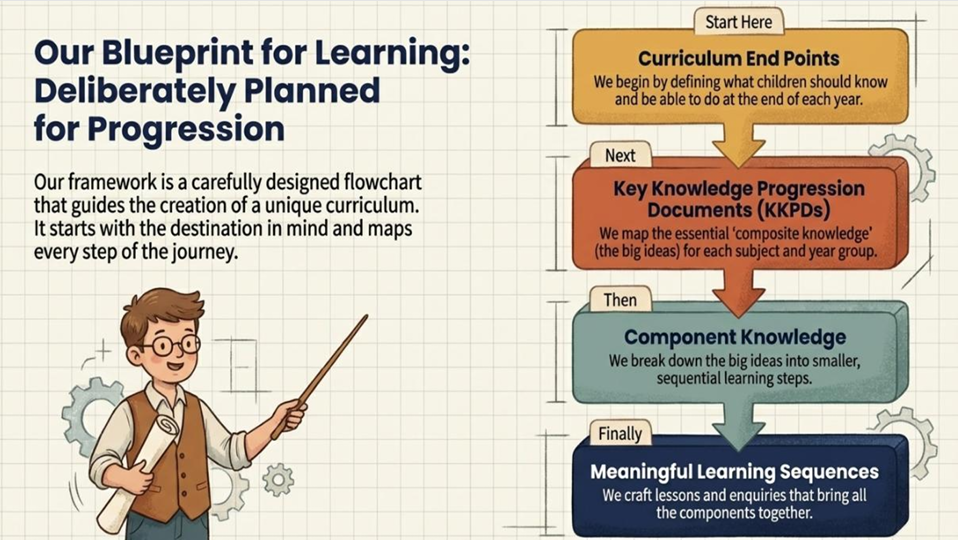

Lesson Design Graphic
In the same way that our Curriculum Model ensures pupils access an ambitious and aspirational curriculum, lessons at Flying High Academy Ladybrook are shaped using the Lesson Design Model. This framework secures a consistent approach to high-quality teaching and provides clarity, while maximising opportunities for all pupils to learn, achieve and thrive.
Alongside a deliberate and purposeful core curriculum, our foundation subjects are planned for with the same consideration. Each term, every year group is led by an enquiry question, giving each topic a clear sense of purpose and direction. These enquiry questions are designed to spark pupils’ curiosity, encourage them to think deeply and make links beyond the classroom. Rather than simply learning facts in isolation, children explore ideas and build knowledge that helps them answer meaningful questions about the world around them. This approach not only makes learning more engaging and memorable, but also helps children develop important skills such as critical thinking, problem-solving and build confidence in expressing their ideas. By the end of each term, pupils participate in an authentic outcome to demonstrate an answer to their question.
As part of a broad and balanced curriculum, RE is provided for all pupils. Parents do have the right to withdraw pupils from RE. If you wish to do this, make an appointment with the Curriculum Lead/RE Subject Leader via the School Office.
No Nonsense Phonic Scheme
From F2 through to the end of Autumn term in Year 2, we follow the No Nonsense Phonics scheme, with a consistent approach across all classes. Each lesson follows the same sequence, a multi-skills lesson, where a new code (sound-spelling correspondence) is introduced, and a mini-story lesson, where children practise reading that code within the context of a story. This daily routine ensures that new knowledge is systematically taught, recapped, and revisited. Children are given frequent opportunities to practise their reading skills and build fluency. All children are regularly assessed, and those who need extra support receive additional practice throughout the day to help secure their learning and close any gaps.
Launchpad Reading at Flying High Academy Ladybrook
At Flying High Academy Ladybrook, we want every child to become a confident, fluent reader who develops a lifelong love of books. To support this, we deliver Launchpad Reading in Foundation 2 and Year 1. This is a whole-class approach to reading that combines high-quality texts with structured, engaging lessons.
Through Launchpad Reading, children build essential skills in Phonics, vocabulary and comprehension while developing their confidence and enjoyment of literature. Lessons are inclusive and interactive, combining teacher modelling, group discussion and targeted support to meet the needs of all learners.
Reading lessons focus on the following key areas:
- Auditory and visual discrimination – recognising, comparing and distinguishing between different sounds and patterns.
- Decoding – using phonics knowledge to read unfamiliar words.
- Prosody – reading with expression, using tone, pitch, and appropriate pauses to bring the text to life.
- Comprehension – understanding, interpreting, and responding to what is read.
The structure of the week is carefully designed to ensure these skills are taught and revisited in a systematic way:
Lesson 1: Reciting and orally retelling the story.
Lesson 2: Clarifying and exploring new vocabulary.
Lesson 3: Visualising understanding.
Lesson 4: Retrieval of key details.
Lesson 5: Retrieval to consolidate and embed learning.
This consistent approach not only supports children in becoming accurate and fluent readers but also nurtures a love of stories, language, and learning.
Big Cat Collins Reading Books
At Flying High Academy Ladybrook, children are only expected to read books that are carefully matched to their current decodable level. We use Big Cat Collins for Letters and Sounds, a high-quality reading scheme that has been closely aligned to our Phonics programme by the English Hub. This ensures that the books children take home are closely matched to the Phonics they have been taught in school.
All children are regularly assessed and given books that are matched to their individual decodable ability. To support fluency and confidence, children take home the book they have been reading in school during the previous week; this gives them valuable opportunities to revisit a familiar text, practise their skills, experience success, and build confidence when reading at home.
This structured approach ensures that children read with accuracy, grow in fluency, and, most importantly, develop a love of reading.
If you would like to see what a book looks like, please click the link below:
Big Cat Collins Decodable Books
Schofield & Sims Complete Comprehension
Our curriculum is supported by the Schofield & Sims Complete Comprehension programme from Years 1 to 6, which provides a structured and progressive approach to teaching reading. Each unit focuses on a high-quality text and a specific comprehension skill, with new vocabulary introduced and explored before reading begins. This approach ensures children have the language tools they need to fully understand and engage with what they read.
By modelling fluent reading and providing regular opportunities for discussion, guided practice, and independent work, we help children build the skills and confidence needed to read with ease and expression. As they progress through the school, pupils develop a strong foundation in comprehension, an expanding vocabulary, and the fluency needed to tackle increasingly complex texts.