

Maths
Why Early Maths Matters
Strong mathematical foundations in the Early Years set children up for future success. Children need more than counting skills — they need a deep understanding of number, pattern, shape and measure so they can make sense of increasingly complex ideas as they move through school.
Early Maths at FHAL
Mathematical ideas are revisited frequently, practised daily and woven throughout the environment. This means that children remember what they learn and are able to apply it, rather than seeing maths as something separate from everyday life.
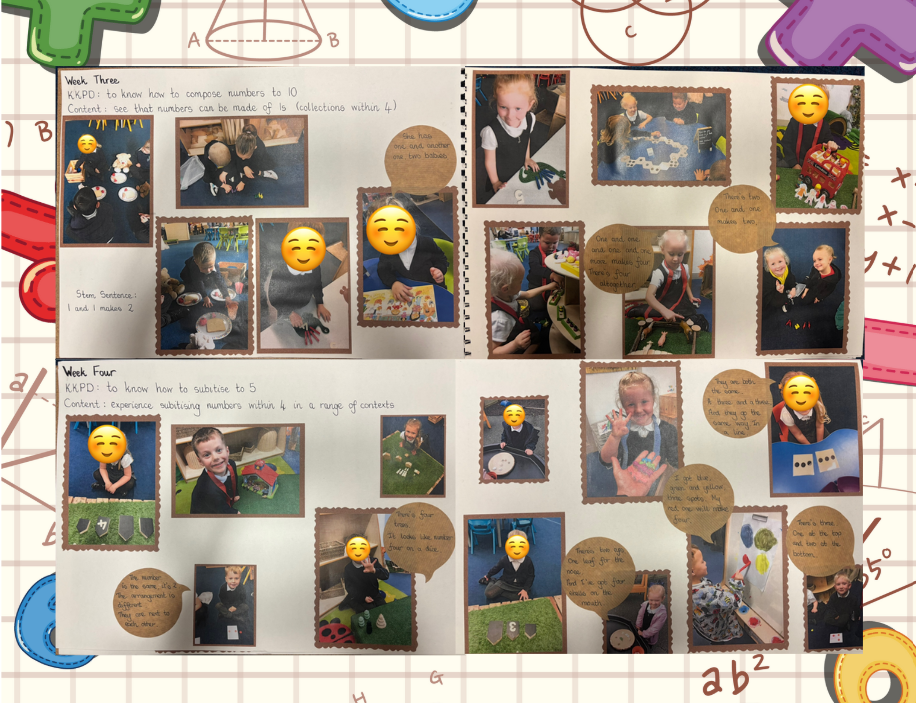
Nursery (F1)
In F1, children follow our Partnership-designed curriculum, created by a Maths Hub specialist and rooted in research. It introduces essential concepts such as:
-
Counting and cardinality
-
Pattern and early algebraic thinking
-
Spatial awareness and geometry
-
Comparing amounts
-
Mathematical vocabulary linked to shape, space, and measure
Children learn through small-group activities, songs, stories, hands-on experiences and purposeful play. They explore maths in a natural and enjoyable way, building confidence and curiosity. This prepares them well for more structured learning in Reception.
Reception (F2)
In F2, we build on these foundations using the NCETM Mastering Number programme. This supports children in developing strong number sense by helping them to:
-
Recognise and represent numbers
-
Spot patterns within numbers
-
Use manipulatives, such as the rekenrek, to understand how numbers are made
-
Develop early calculation strategies
Mastering Number takes place in short daily sessions, giving children regular opportunities to practise and talk about numbers. Alongside this, we teach Shape, Space, and Measure using research-backed materials, including our partnership documentation and selected White Rose Maths resources, ensuring children receive a broad and balanced mathematical education. To further strengthen this, we ensure that there is ample opportunity within the environment to apply and rehearse taught skills.
Transition into Key Stage 1
By the end of Reception, children are:
-
confident with number relationships
-
fluent in key number facts
-
able to compare, explain and reason mathematically
-
ready for the next steps in their learning
In Key Stage 1, children move onto the White Rose Maths curriculum. This builds directly on their Early Years experiences, using concrete resources, pictorial representations and abstract thinking to help children deepen their understanding. Mastering Number continues to feature, ensuring pupils have continued opportunities to rehearse and secure essential number facts alongside daily mathematics lessons.
Mathematics in Key Stage 2
The White Rose Maths journey continues throughout Key Stage 2. Learning is broken into small, connected steps so that all pupils:
-
build on what they already know
-
make meaningful links between concepts
-
reason mathematically and explain their thinking
-
apply their skills to real-life problems
Although maths becomes more sophisticated, pupils still have opportunities to revisit and strengthen their core number knowledge. This ensures that important skills remain secure as children tackle more challenging topics.
Across KS2, pupils develop efficient calculation strategies, explore geometry, measure, statistics, and deepen their problem-solving skills. They increasingly move from concrete to abstract representations, becoming confident mathematicians who can think logically, justify their answers, and approach challenges with resilience.
Our Journey from F1 to Year 6
By using carefully chosen programmes — Mastering Number in EYFS and KS1, and White Rose Maths from Year 1 to Year 6 — we provide a consistent and coherent maths curriculum. Each year builds upon the last, ensuring that:
-
knowledge and skills are secure before new content is introduced
-
concepts grow in depth and complexity over time
-
children understand why mathematical ideas work, not just how to complete them
As a result, every child leaves FHAL as a confident, capable mathematician, ready for the demands of secondary education and equipped with a positive mindset towards mathematics.